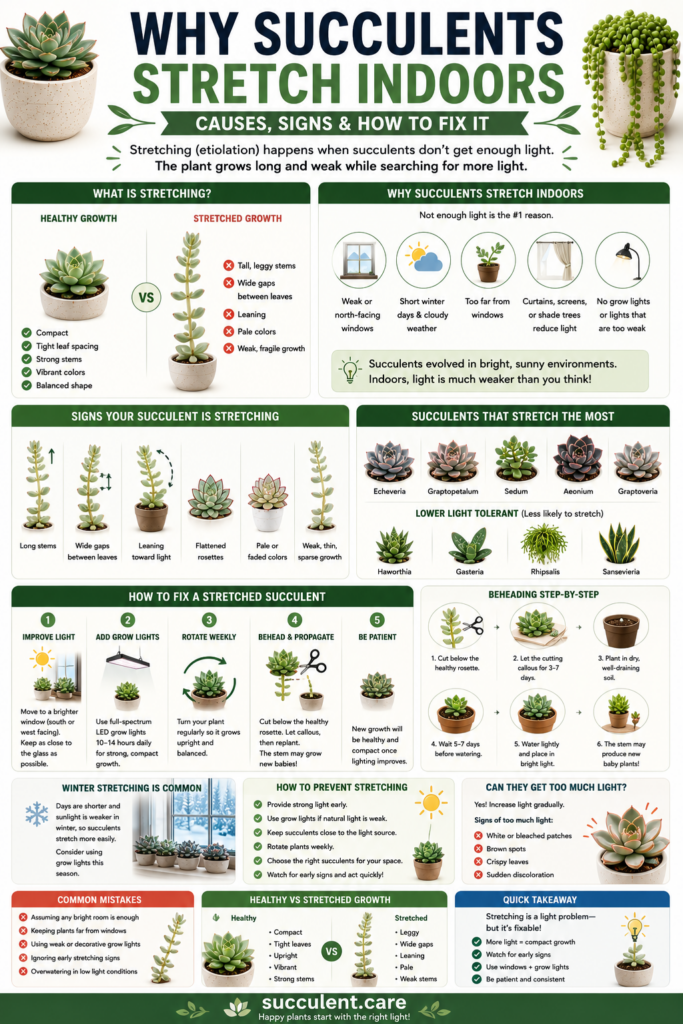
If your succulent suddenly looks tall, leggy, pale, or awkward instead of compact and healthy, your plant is most likely stretching. This is one of the most common problems people face when growing succulents indoors.
Succulent stretching, also called etiolation, happens when a plant is not getting enough light. Instead of staying short and compact, the succulent begins growing upward and outward while searching for more sunlight.
The good news is that stretching is extremely common and usually fixable. Once you understand why succulents stretch indoors and how to correct it, you can help future growth become healthier and more compact.
In this guide, we’ll cover everything you need to know about succulent stretching, including causes, warning signs, prevention, and recovery tips.
Dig in!
What Is Succulent Stretching?
Stretching happens when a succulent grows abnormally long stems or spaces between leaves because it is trying to reach stronger light.
This process is called etiolation.
Healthy succulents usually grow:
- Compact
- Tight
- Balanced
- Dense
Stretched succulents often become:
- Tall
- Thin
- Weak
- Leaning
- Sparse
Stretching is not a disease. It is simply a survival response to insufficient light.
Why Succulents Stretch Indoors
Most succulents evolved in bright outdoor environments with intense sunlight for many hours every day.
Inside homes, light is dramatically weaker.
Even bright rooms often do not provide enough usable light for high-light succulents.
Indoor succulents commonly stretch because of:
- Weak windows
- Short winter days
- North-facing rooms
- Plants sitting too far from windows
- Cloudy weather
- Lack of grow lights
The plant responds by growing toward whatever light source it can find.
Signs Your Succulent Is Stretching
Stretching can happen slowly, so many people miss the early warning signs.
Long Stems
This is usually the first noticeable symptom.
Rosette succulents begin growing upward instead of staying compact.
Wide Gaps Between Leaves
Healthy succulents usually have tight leaf spacing.
Stretching causes leaves to spread farther apart.
Leaning Toward Light
Plants often bend dramatically toward windows.
Flattened Rosettes
Rosette succulents lose their tight symmetrical shape.
Pale or Faded Colors
Many colorful succulents lose vibrant stress colors when light becomes insufficient.
Weak, Fragile Growth
Stretched stems are usually thinner and weaker than healthy growth.
Which Succulents Stretch the Most?
Some succulents are much more sensitive to low light than others.
High-light succulents that commonly stretch indoors include:
- Echeveria
- Graptopetalum
- Sedum
- Aeonium
- Graptoveria
These plants usually need very bright light to stay compact.
Succulents That Tolerate Lower Light Better
Some succulents adapt to indoor conditions more easily.
These include:
- Haworthia
- Gasteria
- Rhipsalis
- Sansevieria
Even these plants still prefer bright light, but they are generally more forgiving.
Why Stretching Happens Faster Indoors
Indoor light is weaker than most people realize.
Even a sunny window provides far less light than outdoor sunlight.
Several factors reduce indoor light:
- Window glass
- Window screens
- Curtains
- Trees outside
- Building shadows
- Seasonal daylight changes
The farther a succulent sits from the window, the weaker the light becomes.
A plant directly on a windowsill may receive dramatically more light than one sitting across the room.
Winter Stretching Is Extremely Common
Many succulents suddenly stretch during winter.
This happens because:
- Days become shorter
- Sunlight becomes weaker
- Cloudy weather increases
- Windows receive less direct sun
A succulent that looked healthy during summer may begin stretching in winter without supplemental lighting.
This is why grow lights become especially helpful during colder months.
Can Stretched Succulents Recover?
The stretched portion of the plant usually will not shrink back down.
However, new growth can become healthy again once lighting improves.
That means recovery is absolutely possible.
The goal is to:
- Improve lighting
- Stop future stretching
- Encourage compact new growth
How to Fix a Stretched Succulent
Move It to a Brighter Window
The first step is improving natural light.
The best windows for succulents are usually:
- South-facing
- Bright west-facing
Keep plants as close to the glass as possible.
Add Grow Lights
Grow lights are often the best long-term indoor solution.
Full-spectrum LED grow lights help:
- Prevent stretching
- Improve color
- Encourage compact growth
Most succulents need:
- 10–14 hours of grow light daily
Rotate Your Plant
Succulents lean toward light sources indoors.
Rotating pots weekly encourages more balanced growth.
Behead and Propagate
Many stretched succulents can actually be rescued beautifully through propagation.
Rosette succulents are especially good candidates.
How to Behead a Stretched Succulent
- Use clean scissors or pruning shears
- Cut below the healthy rosette
- Allow the cutting to callous for several days
- Replant in dry succulent soil
- Wait before watering
The original stem may even produce new baby plants.
Should You Remove Stretched Leaves?
Usually, it is better to wait until the plant begins producing healthy new growth.
Damaged lower leaves naturally dry up over time.
Can Too Much Light Cause Problems?
Yes.
When moving a succulent into brighter light, do it gradually.
Sudden exposure to intense sun may cause:
- Sunburn
- White patches
- Brown scars
- Crispy leaves
This is especially common when moving plants outdoors.
Common Stretching Mistakes
Assuming Any Bright Room Is Enough
Human eyes adjust differently than plants.
A room that feels bright may still be too dim for succulents.
Keeping Succulents Far From Windows
Distance dramatically weakens light intensity.
Using Weak Grow Lights
Many decorative grow lights are too weak for high-light succulents.
Ignoring Early Stretching Signs
Mild stretching is easier to correct than severe etiolation.
Watering Too Much During Low Light
Low light slows growth and soil drying.
Overwatering stretched succulents often leads to rot.
How to Prevent Succulent Stretching
Prevention is much easier than correction.
Provide Strong Light Early
Healthy lighting from the beginning prevents most stretching problems.
Use Grow Lights if Needed
Grow lights are often essential for apartments or darker homes.
Choose the Right Succulents
Some species naturally adapt to indoor life better than others.
Monitor Seasonal Changes
Winter lighting often needs adjustments.
Healthy Succulent Growth vs Stretched Growth
Healthy succulents typically have:
- Tight leaf spacing
- Compact growth
- Upright stems
- Vibrant color
- Balanced rosettes
Stretched succulents usually show:
- Elongated stems
- Wide leaf gaps
- Leaning growth
- Pale colors
- Flattened shapes
Learning to recognize these differences early helps prevent severe etiolation.
Final Thoughts on Why Succulents Stretch Indoors
Succulent stretching indoors is extremely common because most homes simply do not provide the intense sunlight many succulents evolved to need.
The good news is that stretching is usually fixable with:
- Better windows
- Grow lights
- Proper placement
- Consistent monitoring
If your succulent is stretching, do not feel discouraged. Almost every indoor succulent grower experiences this at some point.
Once lighting improves, your plant can begin producing healthier, more compact growth again.
Frequently Asked Questions
Why is my succulent growing tall?
Your succulent is most likely stretching because it is not receiving enough light.
Can a stretched succulent go back to normal?
The stretched portion usually stays stretched, but new growth can become compact again with better lighting.
What causes succulent etiolation?
Etiolation is caused by insufficient light.
Should I cut off stretched succulent growth?
Many stretched succulents can be beheaded and propagated successfully.
Are grow lights good for stretched succulents?
Yes. Strong full-spectrum LED grow lights are one of the best ways to prevent and correct stretching indoors.
Back to: Complete Indoor Succulent Care Guide